INERTIA INVENTORY
🚀 Overview
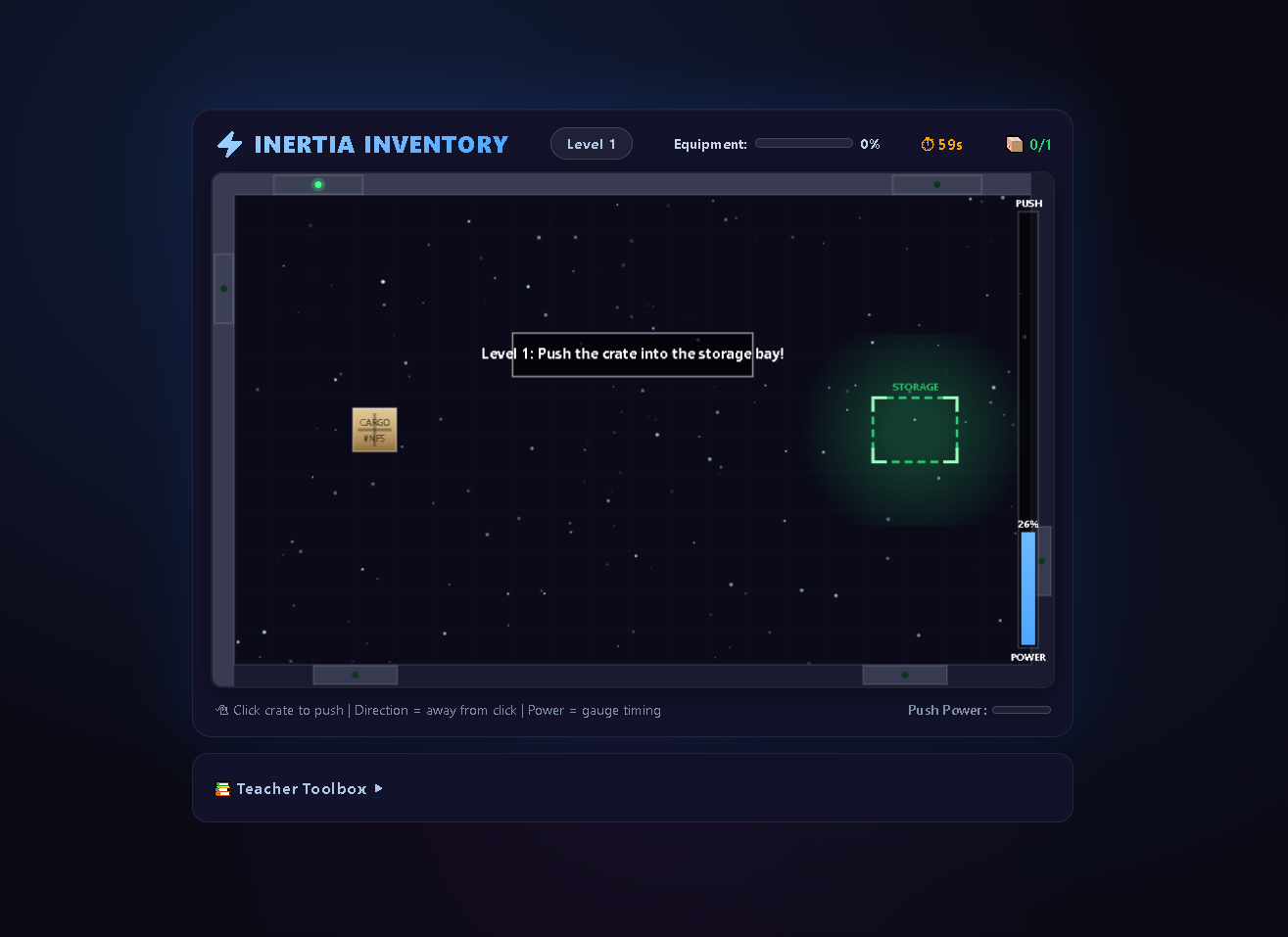
Inertia Inventory is an interactive physics simulation that demonstrates Newton's First Law of Motion (the Law of Inertia). You control crates in a zero-friction environment—once pushed, they keep moving forever unless acted upon by another force. Your goal is to guide crates into the storage bay while avoiding damage to sensitive equipment mounted on the walls.
🎮 How to Play
🖱️ Controls
- Click or tap on a crate to push it
- Push direction = away from your click point
- Push power = determined by the oscillating gauge (click when the gauge is high for a strong push, low for a gentle nudge)
📦 Objective
- Level 1: Store 1 crate in the storage bay
- Level 2: Store 3 crates (they can collide with each other!)
⚠️ Avoid Equipment Damage
- Crates hitting the walls damage sensitive equipment
- Damage > 50% → Mission aborted
- Watch the equipment zones—they glow green when healthy, red when damaged
🔬 Physics Mechanics
Newton's First Law (Inertia)
An object at rest stays at rest, and an object in motion stays in motion with the same speed and in the same direction unless acted upon by an unbalanced force.
In this game:
- No friction — crates never slow down on their own
- Crates only stop when they enter the storage bay (and decelerate)
- Wall collisions reflect crates (conservation of momentum)
Elastic Collisions (Level 2)
- Crates bounce off each other conserving momentum
- Kinetic energy is preserved — watch speed transfer between crates
- Collision particles show impact intensity
Reflection Angle
- Angle of incidence = Angle of reflection
- A crate hitting a wall at 30° bounces off at 30° on the other side
- This mirrors light reflection in optics!
📊 Game Systems
⏱️ Timer
- Level 1: 60 seconds
- Level 2: 75 seconds
- Time runs out → Mission failed
📦 Storage Bay
- Crate must enter the bay with low speed (< 2.2 units)
- Captured crates are "stored" and removed from play
- Level 2 has a larger storage bay to accommodate more crates
⚡ Push Power Gauge
- Oscillates between 5% and 100%
- Click when gauge is high → strong push (faster, more momentum)
- Click when gauge is low → gentle push (precise control)
- Strategy: Use gentle pushes for precision, strong pushes for speed
🛡️ Equipment Damage
- 6 equipment zones mounted on walls
- Each hit causes damage proportional to impact speed
- Damage visual: Green → Yellow → Red (blinking)
- Critical damage (50%) → Game over
💡 Strategies
Level 1 (Single Crate)
- Start gentle — push the crate toward the bay with moderate power
- Correct course — if it misses, nudge it from the side
- Slow down — let the crate decelerate naturally before entering the bay
- Patience wins — over-pushing sends it ricocheting forever
Level 2 (3 Crates, Collisions)
- Use collision chains — push one crate into another to redirect it
- Clear a path — move crates out of the way
- Storage bay is larger — take advantage of the bigger target
- Watch for damage — more crates = more wall hits
General Tips
- Gentle pushes are safer — less speed = less damage
- Angle matters — aim crates at the bay, not at equipment
- Use the gauge — wait for the right power level
- Patience is key — inertia means consequences last forever
🔍 Educational Themes
Core Lesson
Inertia isn't a number — it's a feeling of momentum. A single over-push can send a crate ricocheting endlessly. Restraint is a skill: knowing when not to push hard is just as important as knowing when to act.
Discussion Questions
- Why is stopping harder than starting?
- What happens in a car crash without seatbelts?
- Why do airbags help reduce injury?
- How does inertia affect spacecraft navigation?
Activity: Calculate the Rebound Angle
When a crate hits a flat wall, the angle of incidence equals the angle of reflection. If a crate approaches a wall at 30° from the wall's surface, it rebounds at 30° on the other side. Try tracing the path: measure the incoming angle, predict the outgoing path, then test it in the game!
✨ Features
- 2 levels with increasing difficulty
- Real-time physics simulation (no friction)
- Elastic collisions between crates (Level 2)
- Wall reflection with angle preservation
- Push power gauge for variable force
- Equipment damage system with visual feedback
- Particle effects for impacts and captures
- Timer-based challenge
- Starfield background with twinkling stars
- Teacher Toolbox with discussion prompts and activities
- Responsive design — works on desktop and tablet
- Touch support for mobile devices
🎮 Controls
| Action | Input |
|---|---|
| Push crate | Click/tap on crate |
| Power control | Click when gauge is at desired level |
| Restart | Press R (when game over or won) |
| Open Toolbox | Click "Teacher Toolbox" |
🏆 Win Conditions
Level 1
- Store the crate in the storage bay before time runs out
Level 2
- Store all 3 crates in the storage bay before time runs out
💀 Lose Conditions
- Time runs out
- Equipment damage exceeds 50%
📚 Teacher Toolbox
🧠 Discussion: Why is stopping harder than starting?
In the game, pushing a crate sets it moving forever (no friction). To stop it, you must apply an equal and opposite push at exactly the right moment. This mirrors real-world inertia: a moving object wants to stay moving. In car safety, this is why seatbelts and airbags exist—they provide the stopping force over time to reduce injury.
📐 Activity: Calculate the Rebound Angle
When a crate hits a flat wall, the angle of incidence equals the angle of reflection. If a crate approaches a wall at 30° from the wall's surface, it rebounds at 30° on the other side. Try tracing the path: measure the incoming angle with a protractor on screen, predict the outgoing path, then test it!
💡 Core Lesson
Inertia isn't a number — it's a feeling of momentum. Every action in this game has an enduring consequence. Restraint is a skill: knowing when not to push hard is just as important as knowing when to act.
Key Physics Concepts
- Newton's First Law: Objects maintain their velocity unless a force acts on them.
- Conservation of Momentum: In crate-to-crate collisions, total momentum is conserved.
- Elastic Collisions: Crate bounces preserve kinetic energy—watch the speed transfer!
🔧 Technical Details
- Pure HTML/CSS/JavaScript — No dependencies
- Canvas rendering with smooth animations
- Real-time physics simulation with collision detection
- Particle system for visual feedback
- Responsive design with dynamic scaling
- Touch support for mobile devices
🏫 Educational Value
Physics Concepts
- Newton's First Law (Inertia) — Objects maintain velocity
- Conservation of Momentum — Collision physics
- Elastic Collisions — Energy preservation
- Angle of Reflection — Incidence = Reflection
- Frictionless environments — Space/ice physics
Critical Thinking Skills
- Spatial reasoning — Predicting crate trajectories
- Timing — Using the power gauge effectively
- Restraint — Learning when less force is better
- System thinking — Understanding how multiple crates interact
Download
Leave a comment
Log in with itch.io to leave a comment.